
Quick Answer
If you are a solo DJ adding lighting for roughly 75–200 guest events, there are three practical configurations to consider:
| Setup | Typical Event Size* | Core Lighting | Best For | Transport Load |
|---|---|---|---|---|
| Minimum-Load Rig | 75–100 guests | 2 moving heads + 2 PARs | Smaller events and tight cargo space | Low |
| Balanced Rig | 100–150 guests | 2 moving heads + 4 PARs | Weddings and general mobile work | Low–Medium |
| Expanded Rig | 150–200 guests | 4 moving heads + 4 PARs, or 2 movers + 4 PARs + light bar | Larger dance floors and premium lighting packages | Medium–High |
*Guest count is a planning shortcut, not a hard lighting formula. Room size, ceiling height, ambient light, fixture output, placement, and haze restrictions can all change what you actually need.
For many solo DJs, the Balanced Rig — 2 compact moving heads, 4 compact PARs, and 1 T-bar — is the best all-around starting point.
It adds useful wash coverage without immediately doubling the moving-head cases, mounting hardware, and cabling.
The right choice ultimately depends less on how many lights you want and more on what your vehicle can realistically carry.

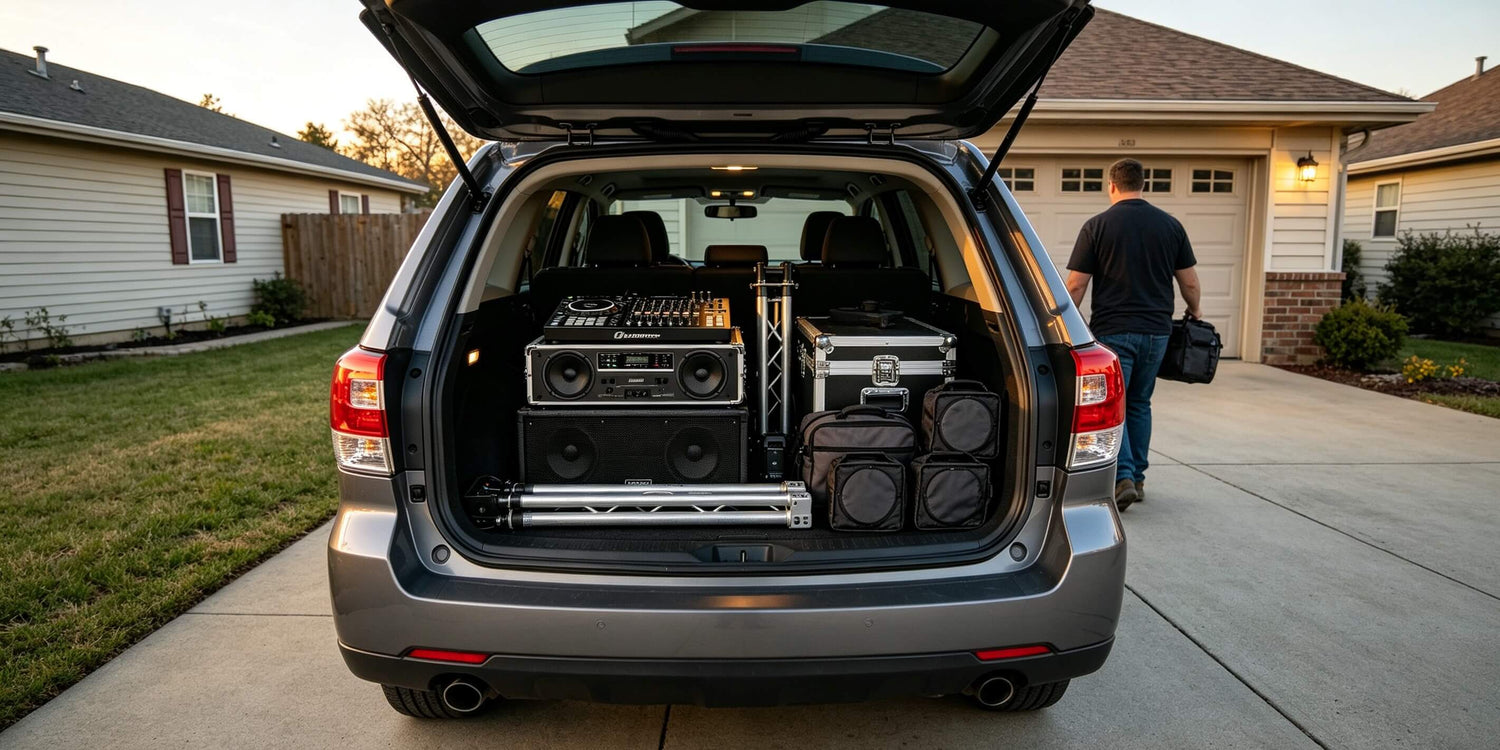
What's Actually Left for Lighting Once the Sound System Is Loaded?
Before picking any fixture, load the gear you can't work without: speakers, subwoofer if you use one, controller, laptop, booth, stands, and cables.
Whatever's left is your lighting budget.
Cargo capacity on paper doesn't tell you how efficiently lighting equipment will actually pack. A vehicle's rated volume and its usable shape for hard cases and long stands are two different things.
Four things determine how much lighting actually fits:
- Hard cases. Moving heads usually need more protection than PARs, so the packed case size — not just the fixture size — is what takes up cargo space.
- The longest single item. Stands, T-bars, and light bars aren't necessarily bulky, but they're long, and one long object can dictate how the whole cargo area packs.
- Accessory bags. Every fixture adds some combination of power cable, DMX cable or adapter, clamp, and safety cable. Four extra lights rarely mean only four extra lights.
- Venue floor space. A rig that fits the SUV but needs four large floor stands may still be impractical once you're setting up in a tight ballroom, restaurant, or private home.
This is the ceiling all three setups below have to fit under.
3 Lighting Rigs for a Small SUV
Setup 1: The Minimum-Load Rig (75–100 Guests)
2 moving heads, 2 PARs, 1 T-bar.
This is the smallest of the three rigs while still giving you two distinct lighting layers: movement from the moving heads and broad color from the PARs.
One moving head per side of the booth gives you basic symmetry, while two PARs handle wash around the DJ area or a smaller dance floor.
Cargo demand stays low because you're limiting the system to four fixtures and one main mounting position.
It is a good starting point if:
- most of your events stay around 75–100 guests;
- lighting is an add-on rather than the main production feature;
- your sound system already takes up most of the vehicle;
- or you're testing whether clients will pay for a lighting upgrade before investing further.
The main limitation is coverage.
Two PARs can create useful color, but you have fewer placement options once the room or dance floor gets wider.
Setup 2: The Balanced Rig (100–150 Guests)
2 moving heads, 4 PARs, 1 T-bar.
The moving-head count stays the same.
That is deliberate.
Two moving heads are already enough to create:
- crossed beams;
- mirrored movement;
- gobo changes;
- alternating colors;
- inward and outward sweeps.
Instead of immediately adding two more moving heads, Setup 2 adds two more PARs.
That gives you fuller wash coverage without adding another moving-head-sized case.
For example, you could use:
- 2 PARs around the DJ booth and 2 toward the dance floor; or
- all 4 across the main rig for wider, more even color coverage.
For weddings in particular, this can be more useful than simply doubling the number of movers. Cocktail hour, dinner, speeches, and slower parts of the night often benefit more from controlled color than constant movement.
If all four PARs stay close to the DJ rig, wired fixtures can also remain practical because power and DMX runs stay short.
Battery PARs become more attractive when you want to move those fixtures away from the rig and distribute them around the room for uplighting.
For many solo DJs working from a compact SUV, this is the best all-around configuration.
Setup 3: The Expanded Rig (150–200 Guests)
Once you're regularly working the upper end of this range, there are two reasonable ways to expand — and they solve different problems.
Option A: 4 Moving Heads + 4 PARs
This is the straightforward upgrade when movement is the limitation.
Four identical moving heads give you:
- two fixture pairs;
- wider symmetrical positions;
- alternating movements;
- more layered looks;
- better visual balance across a larger dance floor.
The tradeoff is significant.
Compared with Setup 2, going from two to four moving heads doubles the moving-head load, along with the clamps, safety cables, power connections, and DMX connections tied to those fixtures.
It also increases the demand on your mounting system.
Do not assume four moving heads should simply be placed on the same T-bar. The combined fixture weight, spacing, clamps, and load distribution all need to remain within the mounting system's rated capacity.
In many cases, Setup 3 will require an appropriately rated mounting system or an additional mounting position rather than simply adding two more fixtures to the existing bar.
Option B: 2 Moving Heads + 4 PARs + 1 Multifunction Light Bar
Instead of doubling the moving-head count, you add one fixture that creates another visual layer through movement, pixels, chases, strobe, or similar effects.
This consolidates several potential small effect lights into one physical unit.
That can mean:
- fewer individual fixtures;
- fewer clamps;
- fewer safety cables;
- fewer separate cable connections;
- fewer packed pieces.
The tradeoff is length.
A light bar can slide neatly beside your speaker stands, or it can become the single longest, most awkward item in the vehicle.
Which option fits better depends on whether your SUV handles one long fixture more easily than a second moving-head case.
This is also the point where cargo stops being a preference and starts becoming the real limit.
Note: The fixture counts above cover the core lighting package only. Mounting hardware, cases, power distribution, and cables can add several more packed items, so plan around the complete load rather than the fixture count alone.
How to Choose the Right One for Your Events
Don't choose purely by guest count.
Start with the type of show you actually sell, then use the transport tradeoffs as a reality check.
- Most of your gigs are small private events → Setup 1. You get a noticeably more complete lighting package without turning lighting into half of your load. It is also a sensible first paid upgrade.
- You do mostly weddings → Setup 2. Two movers give you dance-floor energy when needed, while four PARs remain useful through cocktail hour, dinner, speeches, and slower parts of the night.
- You sell lighting as a premium upgrade → Setup 3. Moving from two to four heads, or adding a multifunction bar, should create a clearly different package that the client can see and justify paying more for.
- Haze is rarely allowed at your venues → Prioritize wash and surface effects. Narrow aerial beams become much less visible in the air without haze, so simply adding more beam fixtures may not be the best use of vehicle space.
- Setup time is already your biggest problem → Stay with Setup 1 or 2. More fixtures rarely make setup faster. A better upgrade may be fewer fixture types, shorter patch cables, better power linking, wireless DMX, or one consolidated effect fixture.
Two mechanical checks apply regardless of the type of event:
- Fixture count doesn't scale evenly. Going from Setup 2 to Setup 3 isn't just “two more lights.” The additional moving heads also bring their own storage, clamps, safety cables, power, DMX, and mounting load.
- Don't upgrade based on the spec sheet alone. Before moving up a setup, physically test-pack the additional case or fixture alongside your speakers. If it only fits through unsafe stacking or an impractical loading arrangement, the larger setup is not ready to become your standard package.
Example: Packing a 150-Guest Rig Into the Trunk
Here's Setup 2 — 2 moving heads, 4 PARs, 1 T-bar — treated as a transport package rather than just a fixture list.
Instead of asking whether six lights fit in the SUV, think of the system as four packed items:
| Packed Item | Contents | Fixture Weight Before Case |
|---|---|---|
| Moving-head case / bags | 2 compact moving heads | ~20 lb / 9.2 kg |
| PAR case / bag | 4 compact PARs | ~23 lb / 10.4 kg |
| Stand bag | 1 folding T-bar | Varies by model |
| Accessory bag | DMX, power, clamps, safety cables | Varies |
Case and bag weight is not included in the fixture-weight figures above. Actual packed weight depends on the protection system you use.
Load the Longest Pieces First
Speaker stands, the T-bar, and booth frame components usually determine the shape of the rest of the load.
Lay those in first, typically along the vehicle floor or side.
Load the Largest Audio Pieces Next
Speakers and the biggest audio cases usually define the remaining rectangular gaps.
This is why lighting should never be planned around an empty trunk.
Your PA normally defines the available lighting space — not the other way around.
Use the Remaining Gaps for Lighting
The two-head case or bags, PAR case, and accessory bag can then fill the remaining usable spaces around the audio system.
This is where compact fixtures matter.
A pair of compact moving heads may fit into one manageable transport position that would be impossible with two much larger fixtures and cases.
Decide What Stays Out
For this 150-guest standard package, that might mean:
- no large totems;
- no full truss;
- no four-head road case;
- no box of miscellaneous effect lights;
- no extra stand unless the venue requires it.
A compact rig is not defined only by what you bring.
It is also defined by what you deliberately leave out of the standard package.
If the fixtures stay close to the DJ booth and available power, you may also be able to keep most lighting cable runs short. Actual extension requirements will still depend on the venue layout and outlet locations.
When evaluating the pack, keep three things separate:
Fixture weight tells you what you're lifting.
Packed-item count tells you how many trips and pieces you're managing.
Cargo footprint tells you whether the equipment actually fits around your speakers and whether the hatch closes.
A rig can pass the weight test and still fail the footprint test.
Test-pack it before making it your standard show.
Compact Betopper Options
Once cargo space becomes the constraint, fixture size and packed practicality matter alongside output.
Setup 1: Minimum-Load Rig
2 × Betopper LB150 moving heads + 2 × Betopper LPC1818 PARs
The LB150 measures 236 × 174 × 329 mm and weighs 4.6 kg / about 10 lb, making a pair easier to integrate into a compact load than many larger moving heads.
The LPC1818 measures 280 × 120 × 300 mm and weighs 2.6 kg, giving you a relatively compact dedicated wash fixture.
This combination covers the two main jobs of Setup 1: movement + wash.

Setup 2: More Moving Effects
4 × LB150 + 4 × LPC1818
This is the more straightforward way to expand the rig when you want more moving effects across a larger dance floor.
Adding two more LB150 moving heads gives you four fixtures to build wider symmetrical looks, alternating movements, and more layered effects. The four LPC1818 PARs maintain the wash coverage from Setup 2.
Because the moving-head count doubles compared with Setup 2, the mounting system becomes an important part of the setup. Check the complete fixture, clamp, and hardware load before deciding how the four moving heads will be supported.
This option makes the most sense when movement and visual coverage are the main reason for upgrading.

Setup 3: Add a Multifunction Light Bar
2 × Betopper LB150 + 4 × Betopper LPC1818 + 1 × Betopper LW2418
Instead of adding another pair of moving heads, the LW2418 adds a different layer of movement, color, chase, and pixel-style effects without requiring two additional moving-head fixtures.
That makes it an interesting alternative for DJs who want to expand the visual package while keeping the moving-head count at two.
The tradeoff is transport length.
The LW2418 is a linear fixture, so its packed dimensions matter more than they would with another compact PAR. Before choosing this option, compare the bar's packed length and mounting requirements with the available space beside your speakers and stands.
This option makes the most sense when you want more visual variety without doubling the moving-head package

What to Compare Beyond Fixture Dimensions
When comparing compact fixtures for any of these setups, look at more than the bare housing size.
Check:
- packed dimensions;
- fixture weight;
- case or bag size;
- standard DMX-512 compatibility;
- available DMX channel modes;
- power linking options;
- warranty coverage;
- replacement-part availability;
- fixture profiles for the controller or software you use.
The most compact fixture on paper is not necessarily the easiest one to own and transport.
FAQs
How many moving heads does a solo mobile DJ actually need?
Two is enough for many 75–150 guest events and keeps cargo demands relatively low. Move to four when you are consistently working larger shows, need more movement across the room, and have confirmed the additional transport and mounting requirements make sense.
Is a T-bar better than separate lighting stands for a small SUV?
For cargo efficiency, usually yes. A T-bar consolidates multiple fixtures onto one support, reducing the number of long packed items and venue floor positions. Separate stands provide better fixture separation but require more transport and setup space.
Should I use battery-powered or wired PAR lights?
Battery PARs make the most sense when you distribute fixtures around a room and want to avoid long power runs. Wired PARs remain efficient when several fixtures stay clustered around the DJ booth or on one shared lighting position.
Should I use flight cases or padded bags?
Both can work. Flight cases provide strong protection but create rigid cargo shapes and add weight. Padded bags are more flexible to pack but offer less protection. Compare the complete packed dimensions and weight, not just the bare fixture.
How do I know whether Setup 3 will fit my SUV?
Do a test pack.
Place the additional moving-head case or light bar into the vehicle with your normal sound system, booth, stands, and cable bags already loaded. If the new package requires unsafe stacking or disrupts the normal loading order, it should remain an optional upgrade rather than part of your

コメントを残してください
全てのコメントは、掲載前にモデレートされます
このサイトはhCaptchaによって保護されており、hCaptchaプライバシーポリシーおよび利用規約が適用されます。