
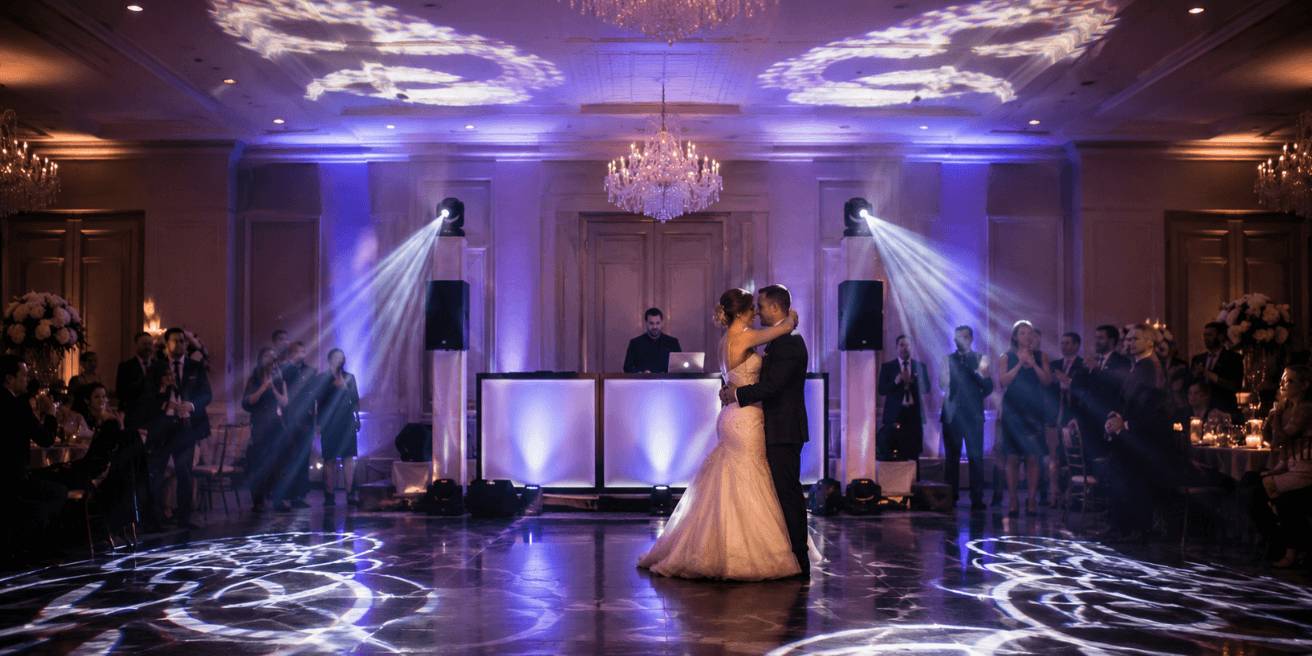
More fixtures don't automatically mean a better show.
Every light you add is also another thing to load, cable, program, troubleshoot, and pack up at 1 a.m. So how much do you actually need?
For most 150–250 guest weddings, 6–8 core dance floor fixtures is a practical sweet spot. Smaller or darker rooms may only need 4–6, while larger ballrooms or more production-focused receptions may benefit from 8–10.
But guest count alone shouldn't decide your rig. Dance floor size, ceiling height, ambient light, fixture placement, and whether the venue allows haze often matter more.
Quick Answer
| Wedding Size | Moving Heads | Wash / PAR Lights | Effect Lights | Core Fixtures |
|---|---|---|---|---|
| ~150 guests | 2 | 2–3 | 1 | 5–6 |
| ~200 guests | 2–4 | 2–3 | 1 | 6–8 |
| ~250 guests | 4 | 3–4 | 1–2 | 8–10 |
These numbers cover dance floor lighting only.
Uplighting is a separate line item. A DJ might use 8–12 uplights around the room without changing the core fixture count above.

Guest Count Isn't the Number That Matters
A 200-person wedding doesn't need twice the lighting of a 100-person one.
What matters is the environment you're lighting. Four factors usually tell you more than headcount ever will.
Dance floor size. A compact floor can look full with two moving heads, a pair of washes, and one effect fixture. A wide ballroom floor may need more wash coverage or more separation between fixtures before it feels balanced.
Ambient light. A dark room gives you contrast for free, so even a modest rig can look impressive. Daylight or bright architectural lighting can swallow subtle effects. In a bright room, stronger coverage and smarter placement may improve the result more than simply adding more fixtures.
Ceiling height. Low ceilings—around 8–12 ft—often favor wider washes, gobos, and controlled movement over extremely narrow aerial beams that do not have much distance to develop. Higher ceilings give moving heads more room to work, but may also require stronger output and better positioning.
Haze policy. This one can change your entire plan. Beam fixtures rely on haze or particles in the air to create a clearly visible aerial beam. Without haze, the beam in the air becomes much less visible, even though the light can still create useful projection on walls, floors, and other surfaces.
If the venue doesn't allow haze, lean more heavily on moving wash, gobos, floor and wall projection, PAR lighting, and matrix effects.
You're lighting the room, not the air.
Build Around Three Jobs, Not a Fixture Count
Instead of counting lights first, build your rig around three roles:
Movement. Coverage. Energy.
Cover those three jobs and you already have the foundation of a balanced wedding show.
Movement — Moving Heads
Moving heads create motion, focal points, and the gobos guests associate with professional DJ lighting.
For many mobile setups, two well-positioned moving heads are enough to establish movement around the booth and dance floor. Four can create more symmetry, wider movement patterns, and bigger visual moments.
But only add more if they are doing something your current pair cannot.
For mobile DJs, versatility is often more valuable than fixture count. A hybrid fixture such as the Betopper BSW200 can cover beam, spot, and wash-style looks in one unit, reducing the need to carry separate fixtures for every effect.
The real question isn't:
"How many moving heads fit on my stands?"
It's:
"Do I already have enough movement for this dance floor?"
Coverage — Wash and PAR Lights
A rig can have great movement and still feel visually empty.
That's usually a coverage problem, not a movement problem.
Wash and PAR fixtures connect the dance floor, DJ booth, backdrop, and surrounding walls into one visual environment. They also handle the softer looks needed during dinner, speeches, and the first dance.
For many wedding setups, two wash fixtures are a practical starting point, while wider dance floors may benefit from additional coverage.
A zoom wash gives you more flexibility because the same fixture can move between tighter and wider looks. The Betopper LM0740, for example, offers a motorized 4.5°–45° zoom range that can adapt to different parts of the room.
Fixed PAR lights are another useful option when you mainly need reliable color coverage without movement.
Energy — Effects
Effects should create moments, not run at full intensity for four hours.
Save strobes, blinders, matrix effects, and other high-energy looks for moments such as:
- the couple's entrance;
- opening the dance floor;
- major choruses;
- build-ups;
- drops;
- peak dance sets;
- the final song.
For a mobile DJ, multifunction effects can help keep the rig compact.
A fixture such as the Betopper LF350 combines matrix and strobe effects in one unit, allowing your moving heads and washes to focus on movement and coverage while the effect fixture handles peak moments.
The formula is simple:
Moving heads create motion.
Wash creates coverage.
Effects create moments.
What Actually Changes Between 150, 200, and 250 Guests?
It's not simply "add two lights every time the guest count goes up."
What changes is usually how much space and coverage the rig needs to handle.
~150 Guests — Keep It Compact
A well-positioned 5–6 fixture rig is often enough for a smaller reception.
The dance floor is usually more compact, so good placement can make a modest rig feel much larger than it is.
Focus on:
-
symmetry;
-
clean wash coverage;
-
useful movement;
-
one strong effect source.
Avoid adding fixtures just because there is still room on the stand.
~200 Guests — The Mobile DJ Sweet Spot
This is where 6–8 core fixtures becomes especially practical.
You have enough equipment to create separate layers of movement, color, and energy while still keeping the setup manageable for a solo operator or small DJ team.
At this size, diversification often becomes more valuable than duplication.
If you already have enough moving heads, the next fixture may be better spent on wash coverage or a dedicated effect.
Think new capability, not simply more of what you already have.
~250 Guests — Add Coverage Before Complexity
A wider ballroom may justify moving toward 8–10 core fixtures.
But that should not automatically mean adding more moving heads.
If movement is already covered, the bigger improvement may come from:
-
wider wash coverage;
-
better fill;
-
stronger output;
-
more evenly distributed fixture placement.
The larger the rig becomes, the more important coordinated DMX programming also becomes.
Ten fixtures running unrelated sound-active patterns can easily look messier than six fixtures working together.
A 7-Fixture Rig That Covers Most of This Range
If you want one setup that can handle a wide range of 150–250 guest weddings, a useful structure is:
-
2 hybrid moving heads — movement, gobos, occasional beam looks
-
2 moving wash lights — wider color and coverage
-
2 PAR lights — fill, booth lighting, backdrop coverage
-
1 matrix / strobe effect — peak dance-floor moments
Seven core fixtures, every one with a job.
A Betopper-based version could use:
The LPC1818's RGB + Lime + Amber + UV color system makes it useful as a flexible wash fixture rather than another narrow effect competing for the same visual role.
The exact models can change.
The important part is the structure.
For a smaller wedding, simplify the placement or leave part of the rig packed.
For a larger wedding, expand the coverage while keeping the same basic system.
Signs You're Carrying Too Much
You may be over-equipped if:
-
several fixtures are doing almost the same job;
-
you rarely use half of your effects;
-
lighting setup takes longer than the rest of your DJ system;
-
fixtures are positioned too close together to create useful separation;
-
the room cannot actually benefit from the extra coverage;
-
adding another light makes programming noticeably harder.
Six well-placed, well-programmed fixtures can easily outperform twelve random ones.
More equipment is useful when it creates a new capability.
It is less useful when it simply gives you more of an effect you already have.
Before adding another fixture, ask:
What does this light do that the rest of my rig can't?
If there is no clear answer, there may be no reason to bring it.
One Rig, Four Moods
Your lighting shouldn't stay in "party mode" all night.
A wedding reception moves through several very different moods, and the same rig should be able to handle all of them.
| Wedding Moment | Lighting Approach |
|---|---|
| Cocktail / Dinner | Warm tones, low intensity, static looks, minimal movement |
| First Dance | Soft colors, slow controlled movement, minimal effects |
| Open Dance Floor | More movement, stronger saturation, faster chases |
| Peak Set | Strobes, matrix effects, faster movement, stronger beam and gobo looks |
The best wedding rig isn't the one that creates the biggest effect at 9:30 p.m.
It's the one that still looks appropriate at 6:30, 8:00, and 10:30 without swapping equipment.
The Short Version
-
150 guests: around 5–6 core fixtures
-
200 guests: around 6–8 core fixtures
-
250 guests: around 8–10 core fixtures
Add uplighting separately if the package calls for it.
Then adjust the rig based on:
-
dance floor size;
-
ambient light;
-
ceiling height;
-
haze restrictions;
-
fixture placement;
-
the type of experience the couple expects.
The best mobile DJ rig usually isn't the biggest one that fits in the van.
It's the smallest one that can reliably deliver coverage, movement, atmosphere, and energy exactly when the room needs it.
Frequently Asked Questions
How many moving heads do I need for a 200-person wedding?
For many 200-person receptions, 2–4 moving heads can provide enough movement when they are supported by wash and effect lighting.
The exact number depends more on dance floor size, positioning, and venue layout than on guest count alone.
Are two moving heads enough for a wedding DJ?
Yes.
Two well-positioned moving heads can work very well for smaller and medium-sized receptions, especially when paired with wash lighting.
Add more when you need wider movement, stronger symmetry, or more complex programming—not simply for the sake of increasing fixture count.
Do I need wash lights if I already have moving heads?
Usually, yes.
Moving heads create movement and focal effects, while wash and PAR fixtures provide broader, more consistent color coverage.
A balanced rig benefits from both roles.
Do wedding DJs need strobe lights?
Not necessarily.
But a strobe, blinder, or multifunction effect fixture can add impact during entrances, drops, and peak moments.
The key is to use those effects selectively rather than constantly.
How many uplights do I need for a 200-person wedding?
That depends more on room layout and wall spacing than guest count.
A medium-sized reception might start with around 8–12 uplights, while larger rooms or full-perimeter coverage may require more.
Plan uplighting separately from your core DJ lighting rig.
Is more DJ lighting always better for larger weddings?
No.
A larger wedding may need more coverage, but that does not automatically mean more of every fixture type.
First determine whether the room needs more movement, more wash coverage, stronger output, or simply better placement.
A coordinated 8-fixture rig can easily look better than a poorly planned 12-fixture setup.
Ready to Build a Wedding Lighting Rig That Works for You?
The right wedding lighting setup isn't about carrying the most fixtures. It's about choosing lights that each bring something useful to the show.
Whether you're building your first mobile DJ rig or upgrading an existing setup with better movement, wider wash coverage, or stronger effects, Betopper offers moving heads, wash lights, PAR lights, effect fixtures, and DMX control options for different venue sizes and budgets.
Build a rig that fits the way you actually work—not just the amount of gear you can carry.

コメントを残してください
全てのコメントは、掲載前にモデレートされます
このサイトはhCaptchaによって保護されており、hCaptchaプライバシーポリシーおよび利用規約が適用されます。