
Introduction
When comparing stage lights, it's easy to assume that the higher the wattage or light output, the brighter the fixture should be. We often see users compare the brightness of a Beam light and a Hybrid moving head and wonder: “If the Hybrid is rated at 400W, why doesn't it look as bright as a 100W or 150W Beam light?” At that point, it's easy to feel like the specification sheet has misled you—or even assume that the wattage must be overstated. But is that really what's happening?
In this guide, we'll break down why Beam, 3-in-1 Hybrid, and PAR lights can look so different in brightness, how beam angle and distance affect what you see, and how to make a more meaningful comparison of light output. We'll also use real Betopper fixtures as examples to show how these differences play out in practice.
Why Do Different Stage Lights Have Such Different Brightness in Real-World Use?
Before comparing numbers, look at what each fixture is actually trying to do with its light. A Beam light, a Hybrid moving head, and a PAR or Wash light may all use powerful light sources, but they don’t send that light into the stage in the same way.
Understanding the Purpose of Beam, Hybrid, PAR & Wash Lights
-
Beam Lights: Concentrated Light
A dedicated Beam light is designed to concentrate its output into a narrow beam. Instead of spreading the light across a large area, it keeps the output tightly focused, which creates the intense beam you see cutting through haze at concerts, clubs, and live events.That concentrated beam can make the light look extremely bright at its center.
Example: Shine a flashlight through a small opening and you get a bright, concentrated spot. Open it up and spread the same light across a wall, and the light looks much less intense in any one place.

-
Hybrid Moving Heads: Multiple Functions
A Hybrid moving head has a different job. It may need to work as a Beam, Spot, and Wash, while also providing functions such as Zoom, Gobo, Prism, and Focus.
Instead of optimizing the entire optical system for one narrow beam, the fixture has to control and redirect light for several different effects. That versatility changes how the available light is distributed and can result in lower peak intensity than a dedicated Beam.
Hybrid fixtures cannot be directly compared to dedicated beam lights for peak brightness. The core design goal of a hybrid (BSW) is multi-effect versatility. All those built-in functions inevitably sacrifice peak beam intensity.
2. Beam angle: the biggest factor.
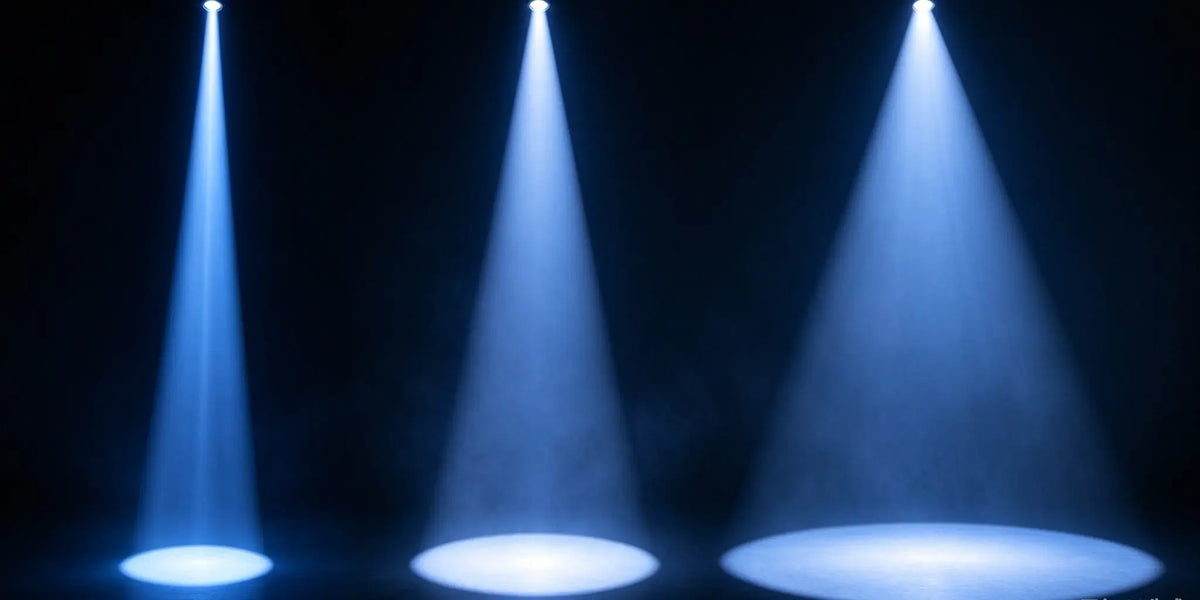
A dedicated Beam is built around a very narrow beam angle, so it packs its light into a much smaller spot. A Hybrid usually has a wider beam and has to cover Spot and Wash modes as well, so the same amount of light is spread over a larger area and the center reads lower.
3. Optical glass count: cumulative light loss.
Each optical surface contributes reflection and absorption loss. With standard anti-reflection (AR) coating, a single glass surface typically loses ~0.5%–1.5%. Uncoated glass may lose 4% per surface. A BSW hybrid carries multiple lenses, prisms, gobos and color filters; losses accumulate across every optical surface, not merely per glass element. A dedicated beam fixture uses far fewer optical surfaces, resulting in much lower cumulative light loss.
4. Lens aperture.
Larger front lenses generally capture and deliver more light to produce higher brightness.
Example: One published spec sheet for an LED PAR lists about 10,300 to 10,700 lumens with each of its three lens options, yet the illuminance at 5 m is 5,468 lux with the narrow lens, 2,264 lux with the medium lens, and 363 lux with the wide lens. The total light barely changed. Only the beam angle did, and the center brightness changed by roughly 15 times.

-
PAR & Wash Lights: Broad Coverage
PAR and Wash fixtures take the idea even further. Their job is generally to spread light across a larger area rather than concentrate it into a tight beam. That's why a PAR or Wash can appear less intense when you look at its center compared with a narrow Beam, while still doing a better job of illuminating a stage, performer, backdrop, or other large area. So you also need to consider the illumination range when comparing brightness.

Wattage, Lumens ,Candela & Lux: What Do They Actually Mean?
When a stage light lists its light source as “150W LED,” “300W LED,” or “400W LED,” it's easy to assume that the higher the number, the brighter the light will be. But the wattage of an LED light source only tells you how much power the source uses. It does not tell you how much light can actually reach a specific point on the stage. So how should you read these specifications when comparing the brightness of different types of stage lights? First, you need to understand four basic concepts: wattage, lumens, Candela (cd) and lux.
-
Wattage (W): Electrical Power Input
Wattage measures how much electrical power the fixture’s light engine consumes. It tells you how much electricity the fixture draws from the power supply. Wattage does not tell you how much visible light the fixture produces. -
Lumens (lm): Total Luminous Flux
Lumens work well when evaluating broad wash coverage, but they are a poor metric for judging aerial beam punch. A fixture can have high total lumens yet spread that light over a very wide angle, resulting in a soft, low-intensity wash beam. -
Lux (lx): Target Illuminance.
How much light actually lands on a specific surface (1 Lux = 1 Lumen per square meter). Lux is what the human eye perceives as brightness. -
Candela (cd): On-Axis Luminous Intensity
Candela measures luminous intensity along the central optical axis. This is the most important metric for evaluating aerial beam effects and long-throw performance. Candela defines how concentrated light is in a single, forward direction. This directly controls how sharp and visible a beam shaft appears when cutting through haze or fog.
The Relationship Between Candela and Lux
Candela (cd) and lux (lx) describe linked but separate light measurements.
- Candela: How strong the light beam is coming from the fixture in one direction
- Lux: How much light lands on a surface (stage, backdrop, performer)
They follow the inverse-square law: E = I / d²
Where:
- E = illuminance (lux)
- I = luminous intensity (candela)
- d = distance from fixture to target (meters)
How Candela and Lux Work Together
A. Beam Angle
When total lumen output and optical efficiency are similar:
- Narrow beam: Light squeezed into a tight cone → higher candela → higher lux on the target
- Wide beam: Light spread out over a large area → lower center candela, wider coverage
This is why dedicated beam lights produce much higher center lux than hybrid or wash lights.
B. Distance
Lux drops quickly as you move the fixture farther away:
-
1 m: E = I
-
5 m: E = I / 25
-
10 m: E = I / 100
Key Rule: Double the throw distance, lux falls to ~1/4. Candela of the fixture stays the same. Note: This is an approximation for real stage lights.
Practical Calculation Example
A fixture reads 25,000 lux at 10 m, beam hits the surface straight on.
I = E × d²
I = 25,000 × 10² = 2,500,000 cd
The fixture’s center beam intensity is ~2.5 million candela.
Important Note About Haze
Published Lux and Candela values describe measurable light output under specified conditions. The visibility of a beam shaft in the air is a different matter: it depends largely on light scattering from haze, fog, or airborne particles.
Without enough haze or fog, even a high-intensity Beam may be difficult to see through the air, although its light can still illuminate a surface. Haze enhances the visibility of the beam path; it does not automatically increase the fixture's rated Candela or Lux.
How to Compare Stage Lights Professionally
Never compare raw numbers in isolation. A fair brightness comparison requires evaluating fixtures within the same category, at the same distance, and under identical optical settings.
Quick Spec Comparison Matrix
| Fixture Type | Key Metric to Check | Primary Purpose | Common Pitfall |
| Beam Light (e.g., Betopper LB150) | Center Lux @ 10m / 20m | Aerial beam effects, cutting through stage haze, high-energy punctuation. | Comparing Wattage directly to Hybrids or Wash lights. |
| Hybrid Moving Head (e.g., Betopper BSW500) | Zoom Range Lux Curve & Gobo Clarity | Versatile multi-effect lighting (Beam, Gobo projection, mid-range Wash). | Expecting maximum Beam Lux while running color filters or prisms. |
| PAR / Wash Light | Total Lumens & Beam/Field Angle | Key lighting for performers, color washes, background illumination. | Judging performance solely by Center Lux instead of overall field coverage. |
FAQ
Q: Can I compare Lux readings from two fixtures measured at different distances?
Not directly. Lux generally decreases as distance increases. For a fair comparison, use the same measurement distance and comparable beam angles and test conditions. Under suitable conditions, the inverse-square law can help estimate how illuminance changes with distance, but it should not be applied blindly to every fixture and measurement setup.
Q: Do color filters or prisms affect beam brightness?
Yes, they can affect the result, but in different ways. Color filters absorb some light, while prisms redirect or split the beam, changing how the light is distributed. The effect on center Lux depends on the optical design and operating mode.
Q: If two lights have the same light-source wattage, will they perform identically?
No. Their total light output and projected intensity can differ because of the light source's characteristics, optical design, beam angle, and how efficiently the fixture delivers light to the target.
Conclusion
Light-source wattage alone cannot tell you how bright a stage light will look in your venue. To compare fixtures accurately, consider the light-source specifications, beam angle, measurement distance, operating mode, and optical design.
Choose a dedicated Beam for concentrated aerial effects, a Hybrid for multi-function flexibility, and a PAR or Wash for broad, even coverage. The best fixture is the one that matches your lighting needs—not simply the one with the biggest numbers on its specification sheet.
Explore the full range of Betopper stage lighting to compare Beam moving heads, Hybrid fixtures, and PAR/Wash lights, and find the right lighting solution for your next production.

コメントを残してください
全てのコメントは、掲載前にモデレートされます
このサイトはhCaptchaによって保護されており、hCaptchaプライバシーポリシーおよび利用規約が適用されます。