
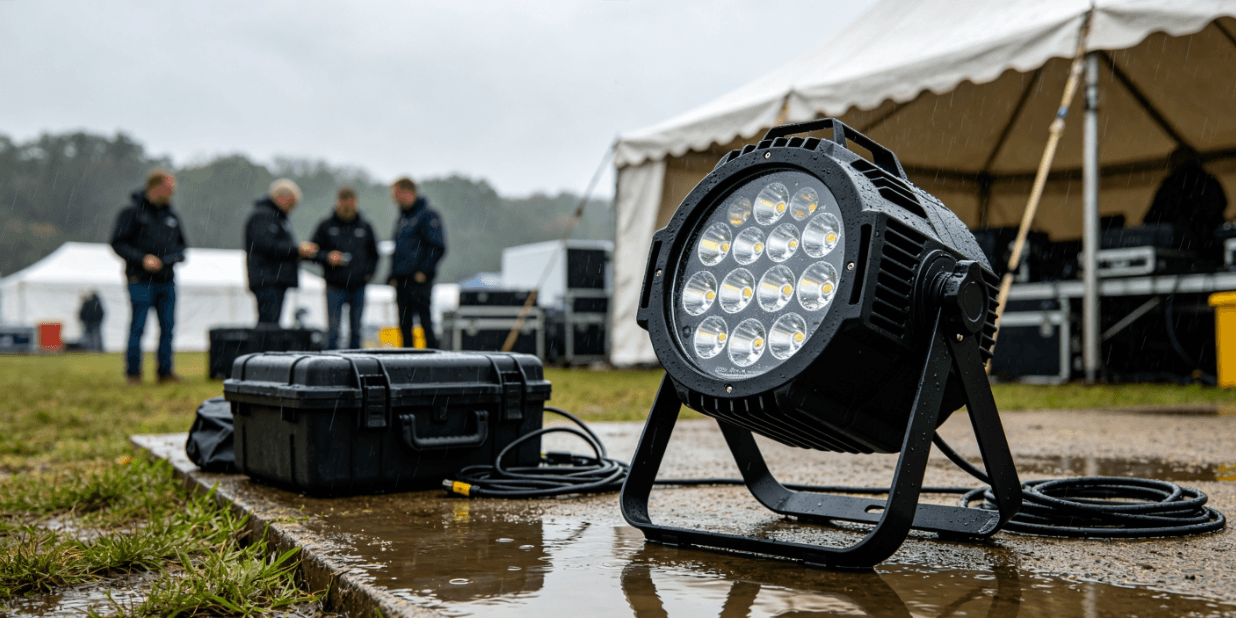
A PAR light that works well indoors isn't necessarily ready for outdoor events.
Once your lighting setup moves outside, the fixture may face rain, dust, humidity, and changing weather conditions. At the same time, outdoor events often require more flexibility in placement, power, and control.
That's why IP65 PAR lights are a popular choice for weddings, mobile DJs, outdoor stages, parties, festivals, and event production.
But an IP65 rating is only the starting point. If you're choosing a PAR light for both indoor and outdoor use, you also need to consider light output, beam angle, color quality, control options, battery life, and portability.
This guide breaks down the key factors to consider so you can choose an IP65 PAR light that fits the way you actually work.
Quick Answer: Is an IP65 PAR Light Suitable for Indoor and Outdoor Use?
Yes. An IP65 PAR light can be a practical choice for both indoor and outdoor applications, particularly for weddings, mobile DJ setups, outdoor stages, parties, and other temporary events.
The IP65 rating means the fixture is dust-tight and protected against water jets. However, it does not mean the fixture can be submerged in water, and proper outdoor installation still matters.
If you're choosing an IP65 PAR light, don't stop at the IP rating. The right fixture should also provide the light output, beam angle, color control, and portability that match your typical events.

What Does IP65 Actually Protect Against?
IP65 is an Ingress Protection rating that describes how well an electrical enclosure protects its internal components from solids and water.
The two digits have different meanings:
- 6 means the fixture is dust-tight.
- 5 means it is protected against water jets from different directions.
For an outdoor PAR light, this protection can be important when the fixture is exposed to dust, splashes, or rain during an event.
However, IP65 does not mean the fixture can be submerged in water. It is designed for protection against water jets, not underwater operation.
It's also important to remember that the rating applies to the fixture as designed and tested. Cables, connectors, power supplies, and installation conditions still need to be handled properly for outdoor use.
What Should You Look for in an IP65 PAR Light?
Once you've decided that outdoor protection is important for your setup, the next step is looking beyond the IP rating.
A good indoor/outdoor PAR light should match your venue, coverage requirements, color needs, and workflow.
1. Light Output
Start with the area you need to illuminate.
A PAR light for a small wedding backdrop has different requirements from one being used to wash a large outdoor stage.
When comparing fixtures, don't look at wattage alone. Consider the actual light output together with beam angle and throw distance.
For example, a fixture with a wide beam can cover a larger area, while a more concentrated beam can deliver stronger illumination farther away.
2. Beam Angle
Beam angle determines how widely the light spreads.
A wide beam is useful when you want to cover:
- Walls
- Backdrops
- Dance floors
- Tents
- Large stage areas
- Architectural surfaces
A narrower beam is more useful when you need concentrated light or a longer throw.
For general uplighting, a wide wash can help create even coverage. For stage applications, the right choice depends on fixture position and the size of the area you need to cover.
Don't choose a beam angle simply because it looks impressive on a specification sheet. Choose it based on where you plan to place the fixture.
3. Color System
The LED configuration affects both color variety and the quality of your washes.
- RGB fixtures can produce a wide range of basic colors.
- RGBW adds a dedicated white channel, making it easier to create cleaner whites and balanced washes.
- RGBWA adds amber for warmer colors.
- RGBWA+UV adds UV effects while providing multiple color channels for more flexible color mixing.
For weddings, DJs, parties, and event production, a multi-color fixture can give you more options without requiring several different types of PAR lights.
4. Control Options
Think about how much control you actually need.
For programmed stage shows, DMX provides precise control over color, dimming, strobe, and other fixture functions.
For smaller events, you may want something faster and simpler.
Depending on the fixture, useful control options can include:
- DMX
- Wireless DMX
- IR remote
- Auto programs
- Sound-active mode
- Master/slave
If you're using multiple fixtures around a venue, wireless DMX can also reduce the amount of control cabling you need to run.
5. Battery Runtime
For portable event lighting, battery operation can be just as important as weather protection.
A battery-powered PAR light lets you position fixtures where power cables would otherwise be inconvenient or visually distracting.
This can be useful for:
- Wedding uplighting
- Outdoor ceremonies
- Cocktail areas
- Event entrances
- Backyard parties
- Temporary installations
If battery power is important to your setup, check the actual operating time for the modes you use most often. A fixture's maximum advertised runtime may not represent runtime at full output or during intensive effects.
6. Portability and Build Quality
An outdoor PAR light needs to handle more than weather.
If you work events regularly, your fixtures will also be transported, mounted, repositioned, packed, and unpacked repeatedly.
Look at:
- Fixture weight
- Housing construction
- Mounting bracket
- Handle design
- Cable protection
- Connector placement
- Cooling design
For mobile DJs and event professionals, a lighter fixture can make a noticeable difference when you're carrying multiple units to every event.
How Does Beam Angle Affect Your Lighting Setup?
Beam angle deserves extra attention because it directly affects how many fixtures you need and where you can place them.
Imagine you're lighting a wedding reception wall.
With a wide beam, one fixture can cover a relatively large section of the wall. With a narrower beam, you may need more fixtures or closer placement to achieve the same coverage.
The same principle applies to stages.
A wide beam can provide broad wash coverage, while a narrower beam can create a more concentrated look.
Before choosing a PAR light, consider three things together:
Fixture distance + beam angle + area to be covered.
This is usually more useful than choosing a fixture based only on its wattage.
Do You Need a Battery-Powered PAR Light?
Not every user needs battery power.
If your fixtures are permanently installed or always positioned near power outlets, a traditional powered fixture may be perfectly practical.
Battery power becomes more valuable when you regularly need to change fixture locations.
For example, a wedding professional may want to place uplights around a room without running extension cables along the floor.
An outdoor DJ may need to position lights around a venue where power access is limited.
In these situations, battery operation can make the setup cleaner and faster.
The key specifications to compare are:
- Battery runtime
- Charging time
- Operating modes
- Maximum output on battery
- Battery replacement or service options
Is Wireless DMX Useful for Outdoor PAR Lights?
Wireless DMX can solve a different problem from battery power.
Battery power removes the need for a power cable.
Wireless DMX removes the need for a long DMX control cable.
For a multi-fixture setup, this can make placement much easier.
A practical wireless setup might include a DMX controller connected to a wireless transmitter, with compatible PAR lights receiving the signal wirelessly.
This can be especially useful for mobile productions where speed and clean cable management matter.
For users who don't need programmed control, however, IR remote, auto, and sound-active modes may be enough.
Where Can You Use an IP65 PAR Light?
An indoor/outdoor PAR light can cover a wide range of applications.
- Outdoor Weddings
Use PAR lights for ceremony areas, reception spaces, backdrops, tents, entrances, and dance floors.
Battery operation can be particularly useful when you want clean-looking uplighting without long power cables.
- Mobile DJ Events
A portable IP65 PAR can move easily between indoor venues, patios, outdoor parties, and other event spaces.
Wireless control can also reduce setup time when multiple fixtures are placed around the venue.
- Small Outdoor Stages
PAR lights can provide front wash, side wash, stage color, or background illumination.
For longer throw distances, pay close attention to light output and beam angle.
- Festivals and Outdoor Events
Outdoor events often involve dust, moisture, and temporary installations. An IP65-rated fixture can provide additional environmental protection while remaining suitable for different lighting positions.
- Architectural Uplighting
Use PAR lights to illuminate walls, columns, buildings, trees, tents, and other structures.
A wider beam can help create more even coverage across large surfaces.
IP65 PAR Light vs. Standard Indoor PAR Light
If you're deciding between a standard indoor PAR and an IP65 model, think about where the fixture will actually be used.
| Feature | Standard Indoor PAR | IP65 PAR |
|---|---|---|
| Indoor events | ✓ | ✓ |
| Outdoor applications | Limited | ✓ |
| Dust protection | Limited | ✓ |
| Water-jet protection | Limited | ✓ |
| Portable event use | Depends on model | Well suited |
| Outdoor weddings | Less suitable | ✓ |
| Outdoor stages | Limited | ✓ |
If your lighting work is exclusively indoors, paying extra for outdoor protection may not be necessary.
But if you regularly move between indoor and outdoor events, an IP65 PAR can give you more flexibility from the same fixture.
Recommended IP65 PAR Light for Indoor & Outdoor Events
If you're looking for a compact PAR light that combines outdoor protection with portable event features, the Betopper LPD001 is designed for this type of setup.
It combines an IP65 outdoor-rated housing with 9 × 18W RGBWA+UV 6-in-1 LEDs, giving you a wide range of colors, warmer tones, and UV effects in one fixture.
For mobile setups, the built-in 2.4G Wireless DMX helps reduce control cabling, while battery-powered operation makes it easier to place fixtures away from power outlets.
The LPD001 also offers:
- Up to 6–10 hours of Auto Mode runtime
- DMX, IR Remote, Auto, APP,and Sound-Active modes
- 6CH / 8CH / 10CH DMX options
- Up to 25KHz refresh rate
- 4 dimming curves
- 3.5 kg compact design
That combination makes it suitable for users who need one PAR light for indoor events, outdoor weddings, DJ setups, parties, and small event productions.

How to Maintain an IP65 PAR Light Outdoors
Outdoor-rated equipment still needs regular care.
After an outdoor event, inspect the fixture before packing it away.
Check the Housing
Look for cracks, damage, loose components, or anything that could affect the fixture's protective enclosure.
Inspect Cables and Connectors
Check power and DMX connections for visible damage or moisture. Do not assume the fixture's IP rating makes every connection or installation condition safe.
Clean the Fixture
Remove dust, dirt, and residue after outdoor use using the cleaning method recommended by the manufacturer.
Dry Before Storage
If the fixture has been used in wet conditions, make sure it is properly dry before long-term storage.
Avoid Standing Water
IP65 protection does not make the fixture suitable for immersion. Keep the fixture away from areas where water can collect.
Regular inspection and proper storage can help keep your fixtures performing reliably over repeated events.
Final Buying Checklist
Before buying an IP65 PAR light, check more than the IP rating.
Ask yourself:
- Is the fixture genuinely rated IP65?
- How much area do I need to cover?
- What beam angle fits my application?
- How much light output do I need?
- Which LED color system do I want?
- Do I need DMX?
- Would Wireless DMX simplify my setup?
- Do I need battery power?
- How long does the battery need to last?
- Is the fixture easy to transport?
- Are the housing and connections designed for outdoor use?
- What warranty and support are provided?
The right PAR light should fit your entire workflow—not just your weather requirements.
FAQ
Can I use an IP65 PAR light in the rain?
IP65-rated fixtures are designed to provide protection against water jets under specified testing conditions. However, outdoor use should always follow the manufacturer's instructions, and severe weather or standing water should be avoided.
Can an IP65 PAR light be submerged?
No. IP65 protection does not mean protection against immersion. If your application involves possible submersion, you need a fixture with an appropriate higher IP rating.
Are battery-powered PAR lights worth it?
They can be especially useful for mobile DJs, weddings, outdoor events, and temporary installations where running power cables is inconvenient.
What beam angle should I choose for a PAR light?
Choose based on the distance between the fixture and the area you're lighting. Wider beams work well for broad washes and uplighting, while narrower beams are better for more concentrated coverage.
Do I need Wireless DMX?
Not necessarily. Wireless DMX is most useful when you need programmed control over multiple fixtures without running long DMX cables. For simpler setups, remote, auto, or sound-active modes may be sufficient.
Conclusion
If you regularly move between venues, the right IP65 PAR light can give you the flexibility to build one lighting setup for more types of events—from weddings and mobile DJ setups to outdoor stages and private parties.
Looking for the right lighting for your next event? Explore Betopper’s full range of stage lighting solutions to find fixtures designed for different venues, applications, and production needs.

Hinterlasse einen Kommentar
Alle Kommentare werden vor der Veröffentlichung geprüft.
Diese Website ist durch hCaptcha geschützt und es gelten die allgemeinen Geschäftsbedingungen und Datenschutzbestimmungen von hCaptcha.