
Introduction
For event service providers, lighting should not be a random collection of fixtures pulled together before every job.
If you are a mobile DJ, wedding DJ, small event company, party rental provider, or small production team, your lighting setup needs to be more than “whatever lights are available today.” It should become a repeatable service package that you can quote, pack, transport, install, control, and improve over time.
That is the difference between owning lights and selling lighting as a service.
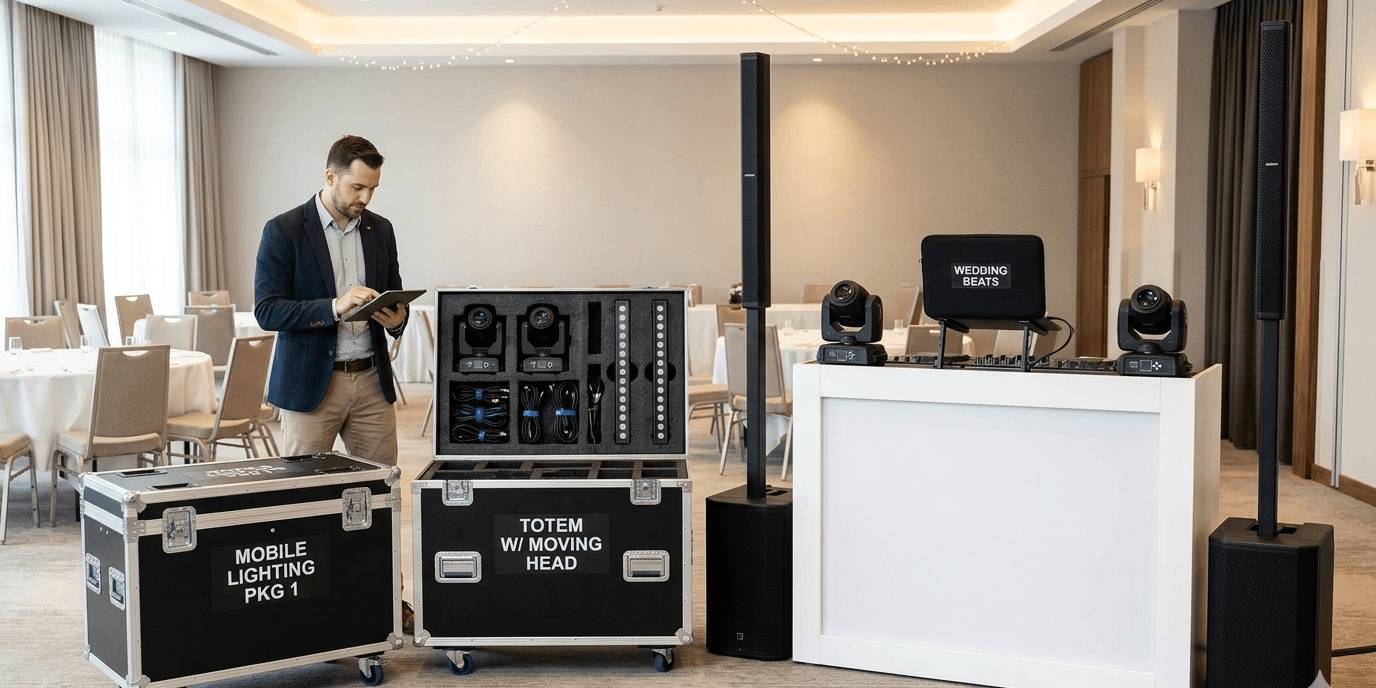
Many event lighting providers already present lighting as packages or add-ons, such as uplighting, dance-floor lighting, moving heads, stage lighting, and effect lighting. Lighting package suppliers also commonly group fixtures, controllers, stands, and accessories together so setup and breakdown are easier to manage.
A repeatable lighting package helps you avoid last-minute guessing. It also makes your business easier to explain to clients, easier to train staff on, and easier to scale.

Why Event Services Need Repeatable Lighting Packages
When every event is built from scratch, small problems happen often.
You forget one DMX cable. A stand is missing. The controller scene does not match the fixture address. The package you sold on the phone is not the same as the gear you load into the vehicle. Setup takes longer than expected, and troubleshooting starts five minutes before guests enter.
A repeatable lighting package solves this by creating a standard system.
Each package should answer:
- What fixtures are included?
- What lighting job does each fixture perform?
- What stands, clamps, and safety cables are needed?
- What controller or control mode is used?
- What cables are required?
- What does the setup look like?
- What checklist must be completed before showtime?
A repeatable package is not just a gear list. It is a service system.
Start With Service Goals, Not Fixture Count
Do not start by asking, “How many lights should this package include?”
Start by asking, “What should this package help the client achieve?”
Different indoor events need different lighting goals.
| Event Type | Service Goal |
|---|---|
| Private party | Simple color, movement, and energy |
| Wedding reception | Elegant mood plus dance-floor excitement |
| School dance / prom | High-impact movement and room coverage |
| Corporate event | Clean, controlled, professional atmosphere |
| Small indoor stage | Visibility, color, and controlled effects |
A wedding reception may need soft color during dinner and stronger movement later on the dance floor. A school dance may need more active beams, strobes, and energy. A corporate event may need controlled colors, cleaner looks, and less random movement.
This is why a package should be built around the event experience, not just the number of fixtures.
Build Packages by Lighting Job
A strong lighting package is built around jobs.
Instead of listing lights randomly, assign every fixture a purpose.
| Lighting Job | Fixture Role |
|---|---|
| Room atmosphere | PAR lights / uplights |
| Dance-floor energy | Moving heads / beam lights |
| Stage or booth wash | PAR / wash lights |
| Special moments | Spot, gobo, or hybrid moving heads |
| High-impact effect | Strobe or matrix effect fixtures |
| Repeatable control | DMX console, software, or saved scenes |
For wedding and event lighting, many lighting professionals separate ambient lighting from active dance-floor lighting. Ambient lighting helps shape the room mood, while active lighting creates party energy and movement.
That same idea works well for event service packages.
A Basic Package may focus on atmosphere and simple movement.
Create Three Package Levels Clients Can Understand
Most event services do not need ten complicated lighting packages. Three clear levels are usually easier to sell, easier to explain, and easier to manage.
The goal is not to make clients compare every fixture. The goal is to help them understand what each package delivers.
Basic Package
A Basic Package should be simple, fast, and reliable.
It may be used for small private parties, birthday events, small DJ booths, and budget-conscious clients.
The goal is:
- Basic room color
- Simple movement
- Fast setup
- Easy control
- Low transport complexity
This package should not be overloaded. If it takes too long to install or requires too much programming, it is no longer basic.
For smaller packages, complex programming is not always necessary. Sound-active mode, remote control, master-slave mode, wireless DMX, or simple app-based control can be useful for quick indoor events where speed matters more than advanced scenes.
However, the control method still needs to be repeatable. If your Basic Package uses sound-active mode, your Standard Package uses a DMX console, and your Premium Package uses wireless DMX or programmed scenes, each package should have its own setup steps, labels, and pre-show test process.
Standard Package
A Standard Package is often the best fit for weddings, private events, and small corporate gatherings.
It should provide:
- Room atmosphere
- Dance-floor movement
- Cleaner fixture placement
- Basic DMX scenes
- Better cable management
- A more polished client experience
This is where your lighting starts to feel like a professional service rather than an accessory.
Premium Package
A Premium Package is for clients who want a stronger visual experience.
It may be used for school dances, proms, corporate parties, larger weddings, and higher-budget indoor events.
This package can include:
- More fixture zones
- Moving heads
- PAR or wash coverage
- Matrix strobe or effect fixtures
- Better control scenes
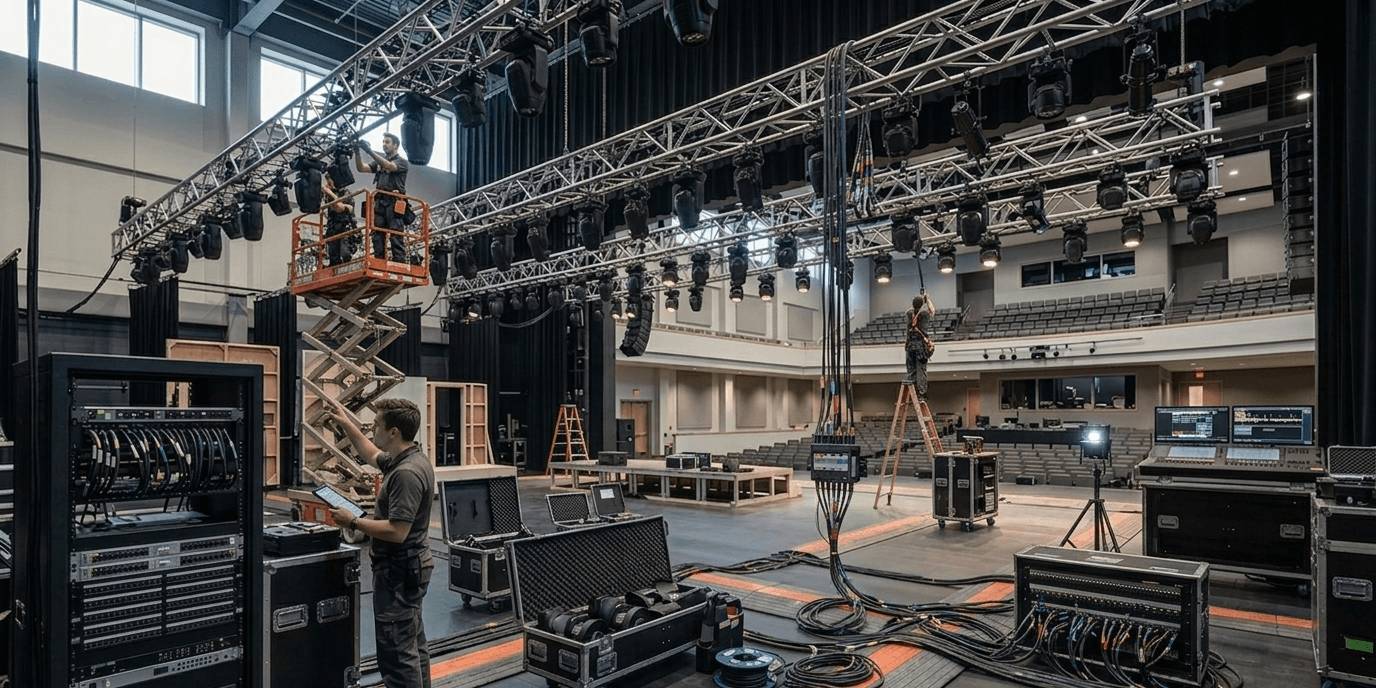
- Totems, truss, or cleaner presentation
- A stronger pre-show checklist
The premium difference should be visible to the client. It should not just be “more fixtures in the same place.”
Standardize the Gear List for Each Package
Once you define the package levels, standardize the gear.
Every package should have a fixed checklist:
- Fixtures
- Stands or totems
- Clamps
- Safety cables
- DMX cables
- Power cables
- Controller
- Spare cables
- Gaffer tape or Velcro
- Cases or bags
- Setup checklist
Digital DJ Tips’ pre-gig checklist includes lighting, stands, clamps, control units, DMX cables, mains cables, truss, haze/fog accessories, and other event essentials, showing that lighting service preparation includes much more than fixtures alone.
For your own business, each package should have its own loading list.
Example:
| Package | Must-Have Items |
|---|---|
| Basic | Fixtures, 2 stands, power cables, simple control, spare cable |
| Standard | Fixtures, stands/totems, DMX cables, controller, safety cables |
| Premium | Fixtures, effect lights, controller, labeled cases, spares, checklist |
If your team has to rethink the setup every time, the package is not repeatable yet.
A Standard Package may add better dance-floor control.
A Premium Package may add more impact, more fixture zones, and more programmed scenes.
The package should not simply mean “more lights.” It should mean more value, better coverage, cleaner control, and a more reliable client experience.
Make One Core Rig Work Across Multiple Indoor Events
A good event service package should be flexible without becoming random.
The same core rig can serve different indoor events if you adjust placement, color, movement speed, and control scenes.
For example:
- Wedding: warm tones, slow movement, soft wash, elegant transitions
- School dance: beams, faster movement, stronger effects, high-energy scenes
- Corporate event: clean colors, controlled movement, low visual chaos
- Private party: quick setup, strong color, simple dance-floor energy
- Small stage: visibility first, then color and controlled effects
The equipment does not need to change completely for every job. The delivery style changes.
This is how a package becomes profitable. You can use the same core equipment across multiple event types while still giving each client a setup that feels tailored.
Add a Load-In, Pre-Show and Pack-Out Checklist
A repeatable package needs repeatable workflow.
For each package, create three checklists.
Load-In Checklist
Before leaving for the event, confirm:
- All fixtures are packed
- Stands, clamps, and safety cables are included
- DMX and power cables are packed
- Controller is packed
- Spare cables are included
- Tape, Velcro, and tools are ready
- Cases are labeled
Pre-Show Checklist
Before guests arrive, confirm:
- Fixtures power on
- DMX addresses are correct
- Scenes are tested
- Cables are taped or covered
- Stands are locked
- Safety cables are attached where needed
- Blackout scene works
- Backup cable is nearby
Pack-Out Checklist
After the event, confirm:
- All fixtures are back in cases
- Cables are counted and coiled
- Clamps and safety cables are collected
- Controller and power supplies are packed
- Damaged or missing items are recorded
- Maintenance notes are added
A package is only truly repeatable when it can be packed out cleanly and prepared again for the next event.
Price Packages Around Service Value, Not Just Gear Count
A lighting package should not be priced only by how many fixtures are included. Event service providers also need to consider equipment depreciation, transport time, setup and teardown labor, cable management, programming time, maintenance, and the risk of carrying backup gear.
A Basic Package may be priced for speed and simplicity. A Standard Package may include better control, cleaner placement, and more atmosphere. A Premium Package should justify a higher rate through stronger visual impact, more complete room coverage, programmed scenes, better presentation, and a more polished client experience.
The goal is not to charge more only because there are more lights. The goal is to charge more because the package delivers a more reliable and valuable event experience.
When to Upgrade a Package
A package may be ready for an upgrade when:
- Clients ask for stronger visual impact
- The same event type appears repeatedly
- Your current package cannot cover the room well
- A higher package can increase your quote
- Setup time still stays manageable
- Transport space is available
- Control, power, stands, and cables can support the upgrade
Common Mistakes to Avoid
Avoid these common package-building mistakes:
- Building packages only by fixture count
- Making the Basic Package too complicated
- Making the Premium Package just “more lights”
- Forgetting cables, clamps, safety cables, and cases
- Changing the package every event
- Not labeling gear by package
- Skipping pre-show scene testing
- Using advanced fixtures without better control
- Forgetting maintenance records
- Selling a package your team cannot repeat reliably
The best package is not always the biggest one. It is the one your team can deliver consistently.
Final Advice: Sell a Repeatable Experience, Not Just More Lights
If you are building your first repeatable lighting package or upgrading an existing setup, it can help to review your event type, room size, fixture roles, control method, and transport plan before buying more gear.
Betopper’s Free Lighting Solution Service can help you plan a practical indoor lighting setup based on your event needs.

Lascia un commento
Nota che i commenti devono essere approvati prima di essere pubblicati.
Questo sito è protetto da hCaptcha e applica le Norme sulla privacy e i Termini di servizio di hCaptcha.