


Building your first — or next — DJ lighting rig doesn't have to mean guessing at gear lists. A layered mix of moving beams and color wash can create a polished look without an oversized setup. Below, we break down what to buy, how many of each fixture to consider, and approximate budgets for three practical tiers.
How Many Moving Heads Do You Actually Need?
This is the question almost every DJ asks before buying their first lights, and the answer depends on venue size, ceiling height, ambient light, fixture placement, and the effect you want — not budget alone.
- As a practical starting point, two moving heads can work well for many gatherings of around 30–50 people — house parties, small birthday celebrations, or a first booking at a neighborhood bar. Positioned on either side of your DJ table, two fixtures can provide useful dance-floor coverage while keeping your setup light enough to carry solo. Actual coverage will vary with the room and mounting position.
- For many events around 80 guests or more — including wedding receptions, corporate parties, and mid-size clubs — four moving heads offer more flexibility. They can create crossing beams and chase effects that read as a more fully produced show, although larger, taller, or brighter rooms may require additional fixtures.
A useful starting point: if you're already booking three or more gigs a month, consider four moving heads from the start. If you're still testing the waters, two may be enough, and you can add a second pair later without replacing what you've already bought. That's also why we recommend starting with individual Betopper Moving Head fixtures rather than a full bundle if you're not yet sure how many you'll need.
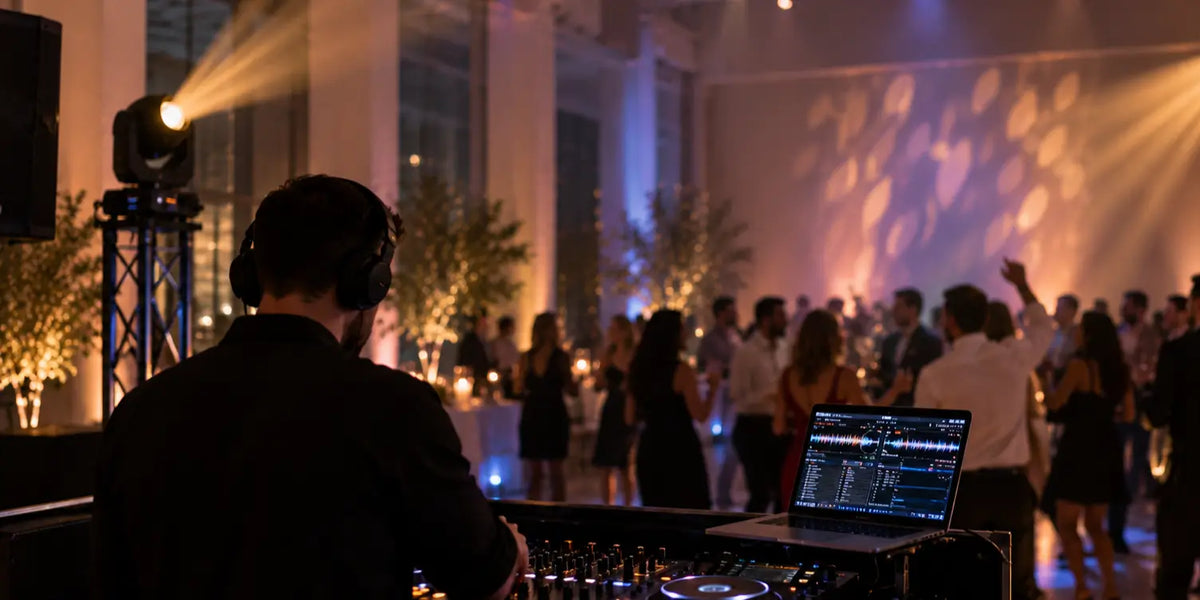
Layered moving-head beams can give even a compact DJ rig depth, motion, and a clear focal point.
Three Budget Tiers to Build Your Rig
|
Tier |
What's Included |
Approx. Total |
Best For |
|
Starter |
2× Betopper LM0740 Moving Head |
$448 |
House parties, small bar gigs, testing the waters |
|
Full Mobile Rig |
4× Betopper LM0740 Moving Head |
$996 |
Independent mobile DJs; many events around 80 guests, subject to venue conditions |
|
Complete Production Rig |
Betopper 12-Fixture Bundle: |
$2,139 |
Weddings, corporate events, and venues that need layered lighting |
Want a showpiece fixture for a high-ceiling venue or a premium booking? Add a single Betopper BSW500 to any tier above. It delivers $5,000-class performance at about $899 — a useful proof point for how far a Betopper build can go. Confirm the current price on the product page before purchase.
Recommended Light Plot for a Small Venue
Layout notes:
- Start by spacing moving heads about 4–5 feet (1.2–1.5 m) apart, then adjust for the room, mounting height, and beam angle. If the beams overlap too heavily at the center of the dance floor, increase the spacing.
- Run PAR lights evenly along the back wall for ambient color. They're there to wash the room, not to point at guests — keep them off faces.
- Mount your DMX controller where you can reach it mid-set, not buried in a gear case. You'll want quick access to switch scenes.
- Venues with columns or booths can take one or two extra PAR units as accent points without disrupting the core layout above.
Programming Your First Light Show
The most common mistake new owners make isn't buying the wrong gear — it's never learning to program scenes, so the lights just sit on one setting all night. Four basic scenes cover almost an entire event:
- Arrival / Cocktail Hour: warm white and amber, low intensity, movement minimal — this is background lighting, not a light show.
- Standard Dance Floor: moving heads on a slow cross-sweep, PAR lights holding a warm color wash underneath. This is your default for most of the night.
- Peak Moments: faster movement, quicker color changes across the whole rig, timed to the track's energy.
- Photos / Last Song: switch back to soft, static white light. No strobing — nobody wants a blurry photo from a flashing light.
Save all four as scene or chase presets on your DMX controller before the event. Being able to call up a look with one button, instead of adjusting settings live, is the single biggest jump in perceived professionalism for a new lighting operator.
Frequently Asked Questions
How many moving heads do I need for a DJ setup?
Two moving heads can be a practical starting point for many gatherings of around 30–50 guests. For events around 80 guests or more, four moving heads provide greater flexibility for crossing beams and chase effects. Room dimensions, ceiling height, ambient light, and mounting position may change the final quantity required.
Do I need a DMX controller, or can I just use sound-active mode?
Sound-active mode is a fine way to start with one or two fixtures. Once you're running two or more lights together, or want consistent scene changes through the night, a DMX controller gives you far more control than sound response alone.
What's the difference between a moving head and a PAR light?
A moving head pans, tilts, and projects patterns — it's your dynamic, eye-catching fixture. A PAR light is fixed in place and washes color across a space. Most rigs use both: moving heads for motion, PAR lights for ambient color.
What's Betopper's warranty policy?
If a fixture arrives defective or develops an issue, Betopper replaces it — no return of the original unit required.
Betopper is the independent, direct-to-consumer brand of Big Dipper, China's largest exporter of stage lighting equipment by customs data. Every fixture is engineered to the same OEM standards trusted by top US brands and sold factory-direct, cutting out distributor and retail markups that inflate the price of comparable gear elsewhere. Betopper holds a 4.8-out-of-5 rating on Trustpilot from 366 verified reviews.


Leave a comment
This site is protected by hCaptcha and the hCaptcha Privacy Policy and Terms of Service apply.