


Introduction
Wedding load-ins are a race against the clock. Between tight venue windows, narrow service elevators, and the familiar “parking is three blocks away” scenario, the physical side of the job adds up quickly. Most DJs don’t burn out from the performance—they burn out from the setup before it.
A strong wedding lighting setup isn’t just about output. It’s about how efficiently the system moves, how quickly it comes together, and how reliably it performs under pressure.
This guide looks at how to move away from a heavy, overbuilt rig toward a lightweight system that delivers the same visual impact with less effort.

1. The Overbuilt Trap: When the System Outgrows the Show
Most wedding lighting rigs don’t fail because they look bad. They fail because they take too much effort to run.
Load-in turns into multiple trips. Cases, stands, cables, and power are all handled separately, often through limited access points and under time pressure. By the time the system is in place, a significant amount of time and energy has already been spent.
And the system itself usually works. The room looks good. The dance floor is covered.
But the workload doesn’t match the result.
Over time, rigs tend to grow without being re-evaluated. Fixtures are added for flexibility or carried over from previous setups, and the system gradually becomes larger than the event actually requires.
At that point, the issue isn’t performance.
It’s efficiency.
2. Lighting for Intent, Not Coverage
Most wedding setups aren’t built from the room. They’re built from habit.
What worked previously gets reused, and what’s already in the van gets packed again. Over time, the system becomes a default rather than a decision.
In practice, the visual priorities in a wedding space are consistent. The dance floor carries most of the energy, and one or two key areas—such as a backdrop or speech position—frame the event. Everything else supports the atmosphere, but rarely demands full coverage.
When rigs are designed to light the entire room evenly, they expand without improving the experience in the same proportion.
A more effective approach is to work from those focal points outward. A small number of well-placed fixtures can define the space, while the surrounding areas provide contrast rather than uniform brightness.
That contrast is what gives the room depth and makes the lighting feel intentional.
3. Selecting Fixtures That Replace, Not Add
Reducing fixture count is only part of the process. What matters is how much each fixture contributes.
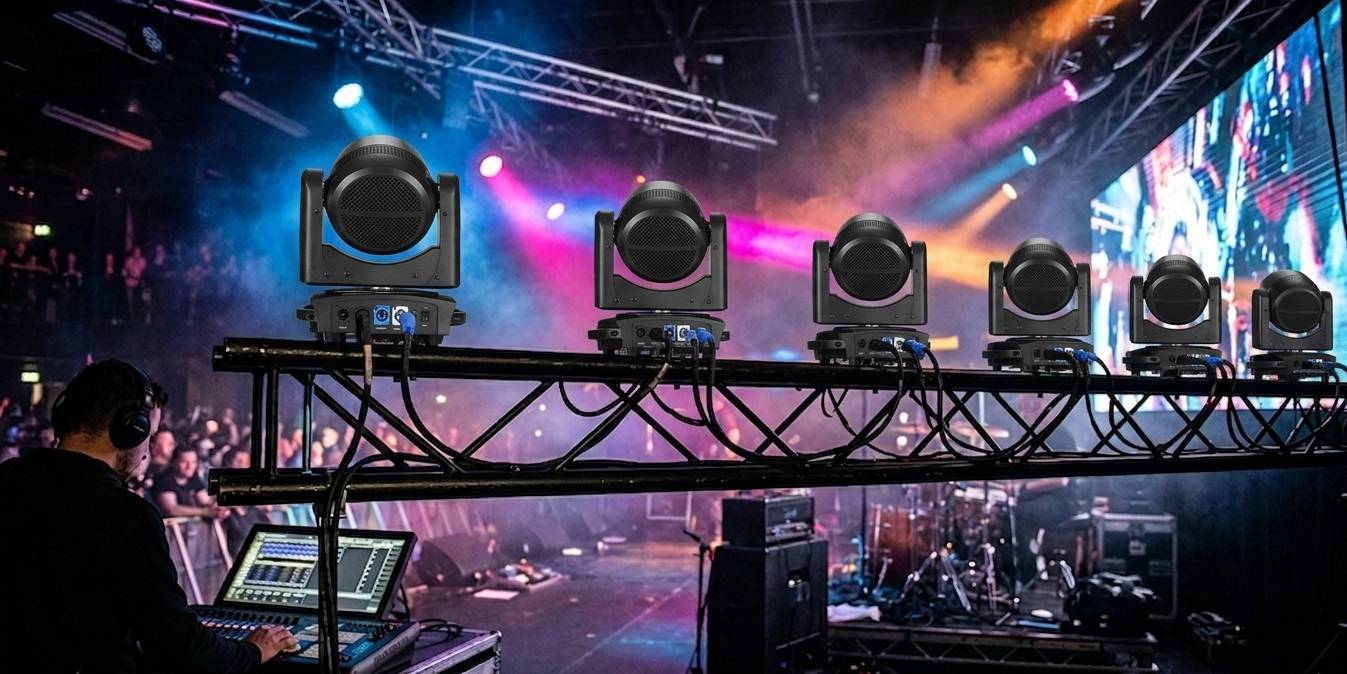
A lightweight system is built around versatility. Fixtures that can shift roles throughout the night—covering wash, movement, and key looks—allow the system to stay compact without feeling limited.
This changes how gear is selected. Instead of layering multiple single-purpose fixtures, the focus moves toward units that can adapt across different moments.
Output still matters, but only when it’s usable. In smaller venues, efficient coverage is more important than raw power. A smaller number of well-sized fixtures will often outperform a larger number of underpowered ones working together.
The same principle applies to color and control. Fixtures that handle both clean white and consistent color reduce the need for separate layers, and systems that simplify cabling reduce time before the show even begins.
At that point, selection becomes less about features and more about impact per fixture.
If one unit allows you to remove another, it’s doing its job.
If you want to see examples of fixtures built around that idea, you can explore lightweight multi-purpose options here:
👉https://betopperdj.com/collections/moving-head-light
4. Building a System That Moves as One
A lightweight rig isn’t just lighter—it’s more cohesive.
In many setups, the challenge comes from fragmentation. Lights, stands, cables, and power are all packed and handled separately, which turns even a small system into multiple trips between the vehicle and the venue.
A more efficient approach is to treat the rig as a set of connected sections rather than individual components. Fixtures remain mounted where possible, cables are organized to reduce rework, and the system is packed in a way that allows it to be deployed quickly.
This changes the load-in from a build process into a placement process.
Instead of assembling everything from scratch, the structure is already there. The time savings are immediate, but the bigger difference is consistency. The system behaves the same way from one event to the next, which removes uncertainty during setup.
Weight still matters, but how that weight is distributed matters just as much. Balanced sections are easier to handle than isolated heavy components, and they allow the entire process to move more smoothly.
5. A Practical Wedding Setup
A lightweight rig only works if it holds up in a real room.
Take a typical small-to-medium wedding venue. You walk in, and within a few seconds you already know where the lighting needs to work. The dance floor is the center of attention, and there’s usually one key visual area—a backdrop, sweetheart table, or speech position—that frames the rest of the event.
Everything else is secondary.
In this kind of space, a compact setup is usually enough. A small number of primary fixtures can cover the dance floor and carry the energy once the night shifts into open dancing. These are the lights people actually notice.
The background is handled differently. Instead of trying to light every wall, a few fixtures placed low or angled toward a single surface create separation and depth. That’s what makes the room feel designed, even when the system itself is simple.
Additional lights only come into play when they change something visible. A small pair might highlight entrances or support speeches, but beyond that, adding more rarely improves what the audience sees.
What defines a strong setup isn’t how many fixtures are used.
Setups like this are typically built around compact, high-output fixtures designed for mobile use, which you can browse here:
👉https://betopperdj.com/collections/sale
It’s whether each one has a clear job.
6. Workflow: From Load-In to Lights On
Most delays during load-in don’t come from complexity.
They come from hesitation.
Gear comes out of the van in pieces, gets set down wherever there’s space, and then gets sorted later. Even with a small system, that kind of workflow stretches setup longer than it needs to be.
A more efficient approach feels different from the start.
The first pieces in are the ones that define the room. Once the main fixtures are in place, the space already looks functional, even if nothing else is finished yet. That early progress changes the pace of the entire setup.
From there, everything else becomes adjustment. Background lighting, accents, and small refinements can be added without slowing things down.
Cabling is where the biggest difference shows. Systems that need to be wired from scratch every time tend to stall. Systems that are familiar—and partially pre-organized—move forward without interruption. There’s less stopping, less second-guessing, and fewer moments where you have to figure out what comes next.
That’s what makes a setup feel fast.
Not rushing—but always moving forward.
7. What Tends to Slow Systems Down
Most systems don’t start inefficient.
They become inefficient over time.
A light gets added because it worked at a previous event. Another gets included for flexibility. Nothing gets removed. The system grows, but the way it’s handled stays the same.
That’s where friction starts to build.
One heavy fixture can slow down the entire load-in. It takes longer to carry, longer to mount, and usually ends up being handled separately from everything else. The rest of the system might be manageable, but that one piece sets the pace.
Inconsistency creates another problem. Different fixture types, different mounting styles, different cable layouts—each variation adds small decisions on site. None of them are major on their own, but together they interrupt the flow of setup.
There’s also the “just in case” factor. Extra lights and accessories that rarely get used still need to be moved, powered, and accounted for. Over time, they become part of the routine, even when they don’t contribute to the result.
None of these issues come from bad decisions.
They come from a system that hasn’t been simplified.
And once that simplification happens, the difference isn’t just less weight.
It’s less resistance in every step of the process.
Final Thought
A wedding lighting rig doesn’t need to be bigger to feel professional.
It needs to be better considered.
When the system is built around what the event actually requires, load-in becomes easier, setup becomes faster, and the result stays exactly where it needs to be.
If you’re looking to simplify your current setup, you can explore lightweight, multi-purpose fixtures designed for mobile DJs here:


Leave a comment
This site is protected by hCaptcha and the hCaptcha Privacy Policy and Terms of Service apply.